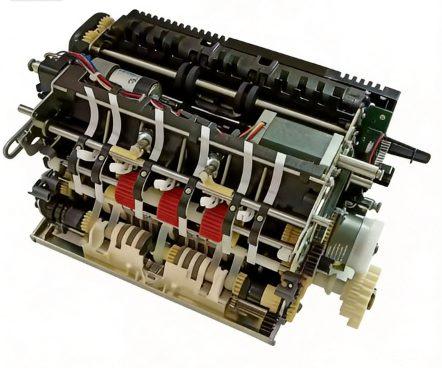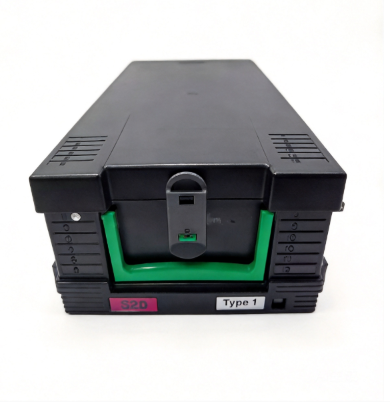
Cash recycling is the highest-value capability inside a modern ATM — and the subsystem most technicians are least equipped to diagnose. This guide runs the Hyosung Bill Recycling Module as the main line, then extends across NCR, Wincor and Diebold recyclers, covering the terminology trap, the failure modes that take machines down, and the part numbers worth keeping on the shelf.
Terminology across brands
The most expensive sourcing mistake in recycling modules starts with the abbreviation. "BRM" is the abbreviation for two different phrases, and other brands do not use the term at all.
- Hyosung — BRM = Bill Recycling Module. This is Hyosung's own term, and the one most people mean when they say "BRM" in the field.
- NCR — BRM = Bunch Recycling Module. Same abbreviation, different full name, different part numbering. NCR's recycling family also includes the GBRU recycler units on the earlier 6626/6634-class SelfServ machines, and the newer Scalable Recycler (SR) generation used on SelfServ 61/62/63 — three different module families, three different parts catalogs.
- Wincor Nixdorf — RM4H recycling module, also listed as VS-MODUL-RECYCLING on the CINEO C4060/C4040.
- Diebold Nixdorf — ECRM (Enhanced Cash Recycler Machine) and BCRM, used on CS 3xxx, ILT 9900 and ILT 923 machines.
Some aftermarket catalogs blur this by labeling NCR recyclers as "BRM" too. Do not copy that habit. Identify the module family first, then the subsystem, then the part number. A "BRM separator" is not one part — it is three different parts depending on whether the machine is Hyosung, NCR or another brand.
Why a recycling module is not just a bigger dispenser
A dispenser does one job — pull notes from a cassette and present them. A recycler does five, every transaction:
- Accept a stack of deposited notes
- Separate them one at a time
- Validate each note for authenticity and fit/unfit condition
- Hold them in escrow until the customer confirms
- Sort good notes back into recycling storage, and route rejects to a separate bin
That fifth step is the entire point of the machine — the note deposited in the morning is dispensed again that afternoon. But it means the note path is roughly three times longer than a dispenser's, with a validator, an escrow and a sorting gate in the middle. More moving parts, more sensors, more to jam.
There is a second reason this category matters for parts buyers: recyclers are also an upgrade path. Hyosung positions the BRM as a core config on its Series 8 and Series 9 bank-grade machines, and non-recycling models can be upgraded to recycling. Every existing non-recycling Hyosung unit in the field is a potential conversion — which drives demand for BRM modules, recycling storage and the related consumables.
The Hyosung Bill Recycling Module (BRM)
Hyosung introduced its first bill recycling module in the early 2000s. Today the BRM family runs from the BRM50 and BRM58 through the BRM100-class across the MX and Monimax platforms, alongside the MS500 teller cash recycler and the MX8100QTN full-function recycler.
The vertical layout is worth knowing before you open the cabinet: on many Hyosung recyclers the deposit and withdrawal paths stack vertically, so the module splits into an upper and a lower replaceable assembly. A fault in the note path will often point to one or the other — not both.
Component-level failure modes, in rough order of frequency
The separator is the first mechanical contact point and the highest-wear item. Its job is to feed exactly one note at a time. When the friction surface glazes or the pad wears, the module double-feeds — two notes travel as one, the thickness sensor trips, and the note goes to reject or jams the path. A recycler that suddenly dumps everything to the reject bin is very often a separator problem, not a validator problem.
Hyosung's recycling storage relies on a drum mechanism that winds accepted notes for later re-dispense. The recycling drum — drum alignment, tension and the note-winding path — accounts for the next failure surface. A drum that is out of alignment or a winding path with paper dust build-up shows up as recycle jams and misfeeds that are hard to reproduce on the bench.
Validation is where thickness and UV sensors do the heavy lifting — thickness detects double-notes and taped notes, UV checks the security features. When these sensors drift or get contaminated, the symptom is over-rejection (good notes routed to reject) or, worse, under-rejection (a security problem). Clean the sensor windows before swapping a board — contamination is the usual cause, not the electronics.
The long note path is full of belts, rollers and feed wheels. Belts stretch and glaze; rollers pick up paper dust and residue. A stretched belt loses tension and slips, producing intermittent transport jams.
The reject bin catches rejected notes and notes the customer left behind. A full or misseated reject bin is constantly misread as a jam or a position error. On Hyosung the reject-bin note-detect sensor is CS14, and its failures show up as reject-bin detect errors. Before replacing anything, check the reject bin is seated and not full.
Brand extensions: NCR, Wincor, Diebold
The same component-level logic carries across the other platforms, with different names and part numbers.
NCR — Bunch Recycling Module (BRM)
Used in the SelfServ 83 (6683) and 87 (6687) interior recycling ATMs, Media Handling 2.0 generation. Up to 4 recycling cassettes plus 1 configurable deposit cassette; cassette capacity to 297 mm and bunch size up to 300 notes for deposit and dispense. The validator is the HVD-300U bill validator. The newer Scalable Recycler (SR) on SelfServ 61/62/63 is a different generation and is not a drop-in parts source for BRM machines.
Wincor Nixdorf — RM4H / VS-MODUL-RECYCLING
The CINEO C4060 (and C4040) carry the RM4H "4+1" recycling module — four recycling cassettes plus one all-purpose cassette, up to 5 cassettes, recycling up to 4 denominations. Deposit/withdrawal of up to 300 notes in a bundle, transport speed up to 10 notes per second. The same cassette interchanges across the CINEO cash series.
Diebold Nixdorf — ECRM / BCRM
Enhanced Cash Recycler Machine (ECRM) and the related BCRM family, used on CS 3xxx, ILT 9900 and ILT 923 machines. Separately, the RM4V recycling devices belong to the DN Series generation and share the V-Cassette family with the DM7V dispenser — same physical interface, different function. Note that ECRM cassettes and V-Cassettes are different families; do not cross-order.
Part number reference
These PNs are drawn from independent parts-market listings and cross-referenced against supplier catalogs. Confirm against the machine's service tag before ordering — recycling modules have running hardware revisions.
Hyosung BRM
- 7430006852 — BRM58 upper module
- S7430006720 — BRM58 bill recycler lower unit
- S7430006560 — BRM50 customer service module
- 7430006281 — BRM50 retract/reject cassette (RTRJC)
NCR BRM (SelfServ 83 / 87)
- 009-0029739 — HVD-300U bill validator
- 009-0029377 — BRM vertical transport
- 445-0746108 — recycler shutter assembly
- 009-0029373 — BRM escrow
- 009-0029370 — BRM pocket
- 009-0029372 — BRM bridge transport
- 009-0029374 — BRM upper transport
- 009-0030511 — BRM spare upper transport section
- 009-0029376 — BRM lower transport
- 009-0029126 — BRM intermediate transport
- 009-0029380 — BRM lower CPU PCB
- 009-0029379 — BRM upper CPU PCB
- 009-0029127 — recycling cassette
- 009-0029129 — reject cassette
Wincor CINEO C4060 / C4040 (RM4H)
- 1750195161 — VS-MODUL-RECYCLING
- 1750200435 — VS module recycling
- 1750178754 — reject cassette
- 1750183504 — cassette RR CAT3 BC lock (note: market listings tie this PN to the C2060/C2070 class — verify fitment before quoting for C4060)
- 1750238381 — reject cassette RR CAT3 BC lock
Diebold Nixdorf ECRM
- 00-149280-000H — ECRM universal recycler (UP)
- 49229513000A — ECRM SR recycle cassette (CS 3xxx / ILT 9900 / ILT 923; also listed as 49-229513-000A)
Error codes worth recognizing
Hyosung recycling modules report both five-digit and seven-digit code formats — newer firmware appends "00" to the legacy five-digit code, so the same fault can appear two ways.
- 20002 / 2000200 — low cash / note shortage
- 20003 / 2000300 — reject bin full
- 20001 — unable to load cassette
- C0056 / C005600 — reject gate not in correct position during reject
- C0058 / C005800 — reject bin not in correct position
- C005C00 — reject bin note detect error (CS14)
- C005B / C005B00 — second cassette misfeed
For NCR, Wincor and Diebold recyclers, error codes are platform-specific and vary by firmware — read them against the service manual for the exact machine, never assume a code means the same thing across brands.
Maintenance that prevents most callouts
The highest-ROI preventive work on a recycling module is mechanical and optical, not electronic:
- Clean the separator and note path on a schedule, not when it jams — paper dust is the root cause behind a large share of double-feeds and sensor false errors
- Clean validator, thickness and UV sensor windows before assuming a validator failure
- Check belt tension and roller condition during every scheduled service — a slipped belt is cheaper to catch than a torn one
- Empty and reseat the reject bin as part of every visit; a full reject bin is misread as a jam constantly
- Blow out optical sensors (including CS14 on Hyosung) — dust produces false errors that no board swap will fix
- Replace separator pads and feed rollers proactively in high-traffic machines rather than waiting for double-feed errors
Sourcing a recycling part without guessing
Recycling modules are the highest-value parts in the machine, so the cost of a wrong PN is the highest too. Three habits keep sourcing safe:
- Confirm the module family (Hyosung BRM vs NCR BRM vs Wincor RM4H vs Diebold ECRM) before anything else — the abbreviation does not transfer across brands
- Read the part against the machine's service tag — running revisions change fitment
- Keep the separator, reject cassette and — for Hyosung — the recycling drum on the shelf as first-line spares, since these account for the largest share of "module down" events
FAQ
Q1. What is a cash recycling module?
A cash recycling module accepts deposits, validates the notes, and reuses those same notes for later withdrawals instead of requiring a separate cash-in-transit fill. It lets a single machine both take and give cash.
Q2. Is a recycling module the same as a cash dispenser?
No. A dispenser only dispenses. A recycler accepts, validates, holds, sorts, and re-dispenses — a much longer note path with a validator, escrow and sorting gate added.
Q3. What does "BRM" actually mean?
It depends on the brand. Hyosung's BRM is the Bill Recycling Module; NCR's BRM is the Bunch Recycling Module. Wincor uses RM4H / VS-MODUL-RECYCLING and Diebold uses ECRM/BCRM. The same abbreviation does not transfer across brands.
Q4. Why does my recycler send every note to the reject bin?
Over-rejection is more often a separator or sensor problem than a validator board failure. Check the separator surface for wear and clean the thickness/UV and validator sensor windows first.
Q5. What is the reject bin for?
The reject bin catches rejected notes and notes a customer left behind. A full or misseated reject bin is frequently misread by the module as a jam or position error.
Q6. What are the most common failure points?
The separator (double-note detection), the recycling drum, the thickness/UV sensors, the transport belts and rollers, and the reject bin. Sensors are the most common source of false errors.
Q7. How do I order the right part?
Confirm the module family first, then the subsystem, then the PN. Read the part against the machine's service tag, because running hardware revisions change fitment.
Q8. What should I keep on the shelf?
A separator and a reject cassette are the highest-value first-line spares; on Hyosung add the recycling drum. Belts and rollers are the next tier for high-traffic machines.
Copyright Owned by Guangzhou MicroLinkpro Technology Co., Ltd.
Website: microlinkpro.com
Email: linda.zhou@microlinkpro.com
WhatsApp: +852 93572135
Author: MicroLinkpro Technician Team | Date: 2026-09-09