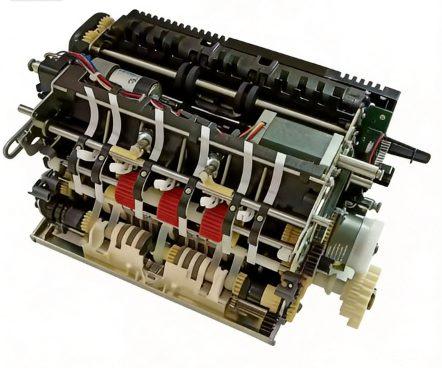
No other part in the cabinet carries a higher unit price than the dispenser, and nothing else in there fails as often. It is also the part that gets ordered wrong most often, and that is rarely down to carelessness. A single fault can point at four different parts, depending on brand, generation and build year, and the vocabulary shifts between them.
What follows covers the four families you will actually meet in the field (NCR S1/S2, Wincor CMD-V4, Hyosung CDU10/HCDU and Diebold AFD 1.5/2.0) through one lens. What are the parts called, where do they fail, and which part number answers which symptom.
Terminology across brands
A lot of dispenser orders go wrong at the vocabulary stage, before anyone reaches for a part number.
Start with the one that trips up the most people. S1 and S2 are generations, not model numbers. NCR reuses model codes across them, so a 6622 has been both an older S1 SelfServ 22 and a newer S2 SelfServ 22. The code on its own will not tell you which dispenser is sitting inside; the build era does, and the machine label settles it. The older generation is fitted with what NCR parts catalogs call a pick *line*. The current S2 generation uses a pick *module*. Quote the wrong one and you buy an S1 part against S2 expectations.
CMD-V4 is short for Cash Media Dispenser – Version 4. Type that abbreviation into a marketplace and you will find it. Type "CDM-V4" and you will find a great many of the same parts, because listings render the name that way just as often. Both spellings sell the same assembly. Search only one of them and you miss a large share of the listings.
TLA means Top Level Assembly. It is not a model number and it is not a sub-part number. A TLA is a complete replaceable assembly, and it carries the price tag to match. Splitting one open to save money is a reliable way to book the same callout twice.
AFD means Advanced Function Dispenser (Diebold). AFD 1.5 and AFD 2.0 parts do not interchange. Earlier Opteva cabinets run AFD 1.5, and the CS 5500/5550 series sits in the AFD 2.0 generation. Once again, the machine label is the only reliable answer.
One more, because it costs somebody a cassette order every year. Personas 58xx machines belong to an older dispenser generation, and S2 cassettes do not fit them.
Where dispensers fail: four zones
Whatever badge is on the front, a dispenser lets you down in one of four places. Get the zone right first. The brand comes next, and the part number last.
Pick. This is where the note is separated from the stack. NCR documents vacuum-based pick with adaptive technology for its S2 generation, and that description belongs on NCR's own datasheets. Do not carry it across to another platform. Check the pick mechanism against each brand's service documentation rather than assuming.
Transport. The note travels toward the presenter. Belts stretch here, rollers glaze over, and the transport mechanism slowly fills up with paper dust.
Stack. Notes accumulate in a tray or a stacker. Worn stacker wheels and trays that are out of alignment give you ragged bundles and half-turned notes.
Present. The shutter opens, and the customer takes the money. Shutter motors and presenter sensors are what fail here. The machine will usually report a timeout instead of a hard error, which is how technicians end up hunting in the wrong module.
Part number reference
Every part number below was cross-referenced against independent parts-market listings before publication. Check the part against the machine label before you order. Dispenser hardware runs revisions, and revisions change fitment.
NCR S2 (current generation)
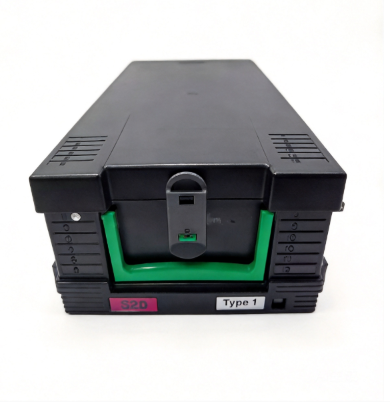
NCR rates the S2 cassette at 346 mm, with capacity up to 2,500 notes (actual capacity varies with note specification and machine configuration).
- 445-0753508 — S2 Single Note Transport (SNT) top level assembly
- 445-0739078 — S2 pick module, shaft upper
- 445-0756286 — S2 pick module motor gear / pulley 36T-26GT
- 445-0761208 — S2 presenter, right-angle FRU
- 445-0753776 — S2 rear access media dispenser
- 445-0756222 / 445-0726671 — S2 cassette, HLA non-TI
NCR S1 (large installed base)
- 445-0592112 — 56XX / 58XX S1 pick line assembly
- 445-0718416 — 6622 / 6625 S1 dispenser control board
- 445-0751703 — S1 dispenser control board, top level assembly
- 009-0007840 — 58XX / 66XX pick valve solenoid
Wincor CMD-V4
- 01750057875 — CMD-V4 horizontal FL transport, 101 mm
- 01750053977 — CMD-V4 clamping transport mechanism
- 01750035778 — CMD-V4 double extractor drive roller shaft assembly
- 01750109659 — CMD stacker module with single reject
- 01750109666 — CMD-V4 stacker module II, vertical, with single reject
- 01750109646 — FSM cash cassette
Hyosung CDU10 / HCDU
- 7430000301 — CDU10 / HCDU front load transport
- 7310000425 — 5600 pick module, FM-7000
- 7430000255 — SF34 note separator, CDU10 / HCDU third and fourth feed module
- 7310000649 — HCDU four-high cassette chassis
- S21685201 / S21685202 — CDU dispense detect photo sensor, emitter / receiver pair
- S45323503 — large dispenser feed belt (14 × 330 × 0.8 mm)
Diebold AFD
- 49242432000A — 5500 AFD picker (AFD 2.0)
- 49225262000A-1 — picker module take-away wheel (AFD 1.5)
- 49248096000C — 5500 AFD stacker tray (AFD 2.0)
- 49242427000C — 5500 / CS5550 AFD 2.0 stacker, ActivDispense
- 49250166000B — Opteva AFD presenter, XPRT 625 mm (AFD 2.0): a presenter, not a picker
Symptom to first part
Find the symptom the customer reports, then start with the part in the right-hand column.
| What the machine does | Where to look first |
|---|---|
| Double notes dispensed | Wincor 3.031.01 → check 01750035778 drive roller shaft; NCR S2 pick module gear set 445-0756286; Hyosung 7430000255 separator |
| Single note will not dispense | NCR 009-0007840 pick valve solenoid; Diebold 49242432000A picker; Hyosung 7310000425 pick module |
| Notes jam in transport | Wincor 01750053977 clamping transport / 01750057875 FL transport; NCR 445-0753508 SNT assembly; Hyosung 7430000301 transport module |
| Bundle comes out ragged | Wincor stackers 01750109659 / 01750109666; Diebold 49248096000C stacker tray or 49242427000C ActivDispense stacker |
| Shutter will not open, or times out | NCR 445-0761208 presenter; Diebold 49250166000B presenter; Wincor 3.050.01 points at the shutter motor |
| Cassette not recognised | Hyosung S21685201 / S21685202 sensor pair; Wincor FSM cassette 01750109646 (CMD-V2 cassettes do not share the same locking geometry) |
Clean before you swap. A contaminated sensor reads exactly like worn mechanics, and a good share of "failed" pick and cassette-detect faults disappear after a clean, with nothing replaced. Cleaning first and ordering second is the habit that keeps a parts budget under control.
Error codes worth recognising
Hyosung uses five-digit codes. Newer firmware reports the same fault with two trailing zeros, so one failure can arrive as 20002 or as 2000200, depending on the machine.
- 20001 — no cassette
- 20002 — low money
- 20003 — reject box is full
- 20005 — CDU setting error
- 2XX15 — note detected on the note path before initialisation (XX = sensor position)
Wincor CMD-V4 codes follow the format X.XXX.XX, where the leading 3 belongs to the dispense subsystem.
- 3.030.01 — pick failure
- 3.031.01 — double note
- 3.035.01 — transport jam
- 3.040.01 — stacker error
- 3.050.01 — presenter timeout
NCR: 40047, dispenser error / cassette misfeed. The full dispenser code set is much wider than this, and codes vary by firmware, so read them against the service manual for the exact machine rather than assuming a code means the same thing on a different platform.
Diebold: DI01 marks dispenser hardware errors, DR01 marks presenter-class errors.
Maintenance that prevents most callouts
Most of the work that prevents callouts is mechanical and optical rather than electronic.
Clean sensors on a schedule, not after something fails. Paper dust and residue account for a large share of false pick and cassette-detect errors, and swapping a board will not fix dust.
Look at belts and rollers at every scheduled service. A glazed roller costs a fraction of the module it eventually takes down, and catching it inside a service window costs you a moment.
On high-traffic machines, replace separator pads and feed rollers before they announce themselves with double-feed errors. Paid downtime costs more than any part on this list.
Keep the presenter shutter travel clear. A shutter dragging on dust reports as a timeout, so the code points at the motor while the thing actually blocking it is grit.
If a board-level fault keeps recurring across several machines of the same generation, check the firmware they are running before you order another board.
Sourcing a dispenser part without guessing
Dispenser parts carry the highest unit price in the cabinet, which is what makes a wrong part number the most expensive mistake in the spare parts chain. Three habits keep it from happening.
Settle the generation before you settle the part. S1 or S2, AFD 1.5 or 2.0, CMD-V4 or CMD-V2: the generation decides what fits, and the part number follows from there.
Read the part against the machine label. The CS 5500/5550 series sits in the AFD 2.0 generation, and a 6622 on its own tells you nothing about which dispenser generation is inside.
Keep pick and transport wear items on the shelf. They cause the largest share of dispenser downtime, and they are also the cheapest parts in the chain. This is the one place where stocking costs less than waiting.
FAQ
Q1. How do I tell an NCR S1 dispenser from an S2?
By the machine's build era and label, not by the model number. S1 and S2 are generations that ran under the same model names, so a 6622 can be either one.
Q2. Are CMD-V4 and CDM-V4 the same thing?
Yes. The official name is Cash Media Dispenser – Version 4, abbreviated CMD-V4. Marketplace listings frequently render it as CDM-V4. Search only one of the two spellings and you miss a large share of the listings.
Q3. Can a Personas 58xx take an NCR S2 cassette?
No. Personas 58xx machines use an older dispenser generation, and S2 cassettes belong to the S2 generation.
Q4. Do AFD 1.5 and AFD 2.0 parts interchange?
No. They are separate generations with separate part families: earlier Opteva cabinets run AFD 1.5, while the CS 5500/5550 series runs AFD 2.0. Check the label.
Q5. What is the most common cause of double notes?
A worn or glazed pick and separation surface, usually combined with a dirty thickness sensor. Clean the sensor path first, then inspect the pick parts.
Q6. How often should dispenser feed rollers be replaced?
On condition, not on a fixed interval. Glazing or paper-dust build-up is the trigger, and high-traffic machines reach it far sooner than quiet ones.
Q7. Which false error codes come from dusty sensors?
Pick failures, cassette-not-detected and dispense-detect errors are the usual ones. Clean the sensor faces before treating any of them as a part failure.
Q8. Which parts should be replaced as a set, and which can go individually?
Pick and separation wear items usually go individually. Assemblies designated as a Top Level Assembly are meant to be replaced whole. Splitting one is what produces repeat callouts.
Copyright Owned by Guangzhou MicroLinkpro Technology Co., Ltd.
Website: microlinkpro.com
Email: linda.zhou@microlinkpro.com
WhatsApp: +852 93572135
Author: MicroLinkpro Technician Team | Reviewed by: Max Liu, CTO (23 years ATM engineering) | Date: 2026-09-16 | Last updated: 2026-09-16